 Innotex Group


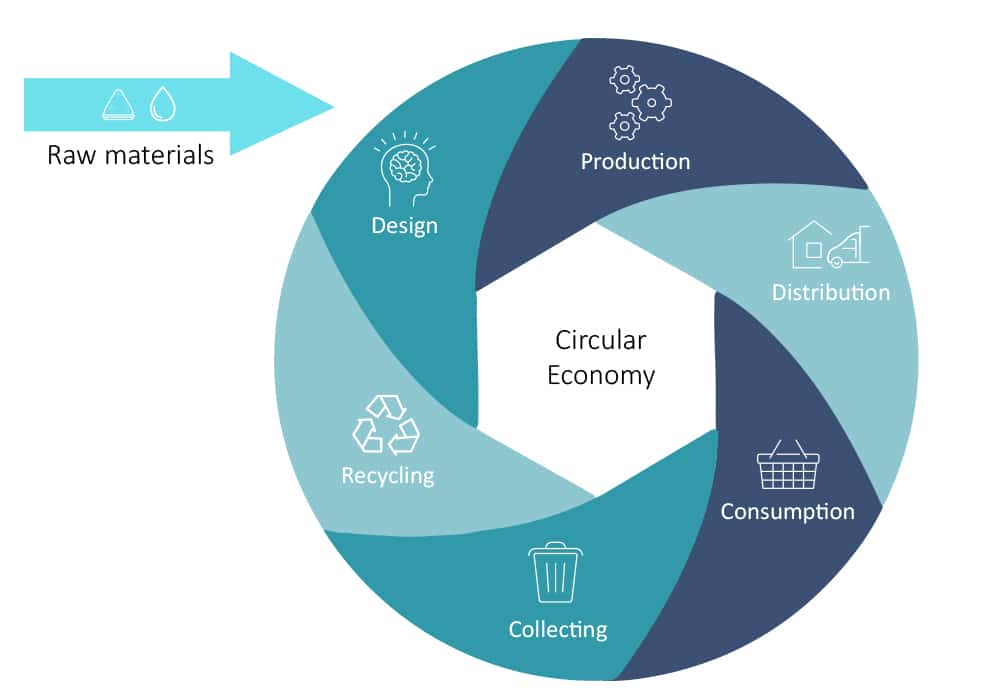
A circular economy refers to a regenerative economic system whereby waste and process by-products are turned into new inputs for new products. The regeneration is achieved through material choice, long-lasting design, maintenance, repair, reuse, remanufacturing, and recycling.
The circular economy perspective is in contrast to a linear economy view. A linear economy takes materials from the earth, makes something with them, and then disposes of them. A linear economy seems to fit much of how we view products today. Oft times, the end-of-life disposal of products we all use tends to find its way to landfills in the US (or more typically incineration in Europe). The convenience of disposability combined with the low cost of many items tends to lead to linear thinking and systems.
Domestic collection systems keep the linear economy disposable society hidden from public view. Where collection systems are not found in various locations throughout the world, the disposal of products and packaging tends to be found in the natural environment and in our waterways. Non-collected disposal is often referred to as leakage. Leakage is visible in our oceans and our lands. The goal of a circular economy is to eliminate leakage and all waste through closed-loop systems.
Closed loop systems seek to acquire the product at the end of its life, reprocess the collected materials in some way and then re-market the new products made to begin the cycle again. The waste from the 1st generation product forms the raw materials for the next product. If any of these steps are missed, we do not have a closed loop. If we cannot collect the items, if we cannot reprocess the items, or we cannot re-market the items, we do not have a closed-loop system. Without closing the loop, used products become “linear” and wind up in landfills or in the natural environment as leakage.
Fast Moving Consumer Goods (FMCGs) are goods designed to have a short life span and are in constant rotation. Products that flow (like packaging) require different strategies for circular value creation than durable goods like electronics or furniture.
Five Strategies for FMCG Circular Flows
- REDUCE: Whenever a product depends on its package in order to be used (ingredients, nutritional’s, safety, branding, protection, etc) the package is an integral part of the product and is difficult to eliminate. When a package is needed, reduce the amount of package size or weight if possible. Using less material is always the best choice. Less material means less energy used in creation, less energy used in transport, and less material to collect at end-of-life.
- REUSE: When possible, collecting, cleaning, and reusing packaging items for the same purpose is desired.
- RENEWABLE & EXISTING SOURCES: Using existing or renewable materials in packaging at creation provides a more circular flow of the package. Incorporating post-consumer or post-industrial recycled content or biobased raw materials into the package drives demand for existing and renewable sources and lowers carbon emissions.
- END of LIFE: RECYCLE or COMPOST Using material that has a chance for a circular end-of-life keeps materials in use and out of landfills. Labeling packages help the end user know what to do with the package at disposal.
- RETHINK: Closing loops keep materials in use. Partnering with others to use byproducts from one process to make other items gives items a next life.
Summit Films produces custom packaging for FMCGs. Summit Films’ sustainable offerings try to connect to the strategies above.
REDUCE: Summit Films can sample alternative materials, lighter gauges, and sizes to limit any excess material. Sampling and smaller trial orders are available.
REUSE: We reclaim, and reuse millions of pounds of plastic every year through our recycling plant. Collecting and re-pelletizing existing plastic helps lower emissions, reduce energy consumption and replace virgin plastics with recycled plastics recovered from the waste stream.
EXISTING SOURCES: Summit Films manufacturers Post-Consumer Recycled (PCR) material, Post- Industrial Recycled content (PIR) material, and Closed Loop material. Closed Loop material is a material made from plastic sent back to us from outside sources to re-pelletize and make new packaging.
END of LIFE: 99% of the products Summit Films manufactures are recyclable at end-of-life. If the end use allows for collection, we can potentially take the material back for re-making new packaging.
RETHINK: Closing loops by returning used materials, cores, boxes, etc allows these materials to remain in the economy. Summit Films looks to collaborate with like-minded partners who would like to return by-products of their process for reuse or recycling.
There are no perfect solutions but moving toward a more circular economy of material flows seems the clear direction. There is a tremendous opportunity for producers like us to be a part of a movement toward a more sustainable, more responsible, and more “circular” way of looking at packaging. A circular economy for packaging incorporates systematic thinking on everything from design to raw materials we source to how we convert those raw materials to end-of-life thinking for the packaging we produce.
We will continue to post blogs to help educate to bring awareness and in turn hopefully meaningful actions by more people.
For a full listing of Summit Films’ sustainability efforts, visit SummitFilms.com/Sustainability
